
ADDIE for Trainers: Do Not Start With Slides
14 May 2026
A practical guide for trainers and facilitators to use ADDIE as a thinking process before building slides, activities, or training materials.
Many training projects begin too late.
Not late on the calendar.
Late in the thinking.
Someone says, "Can you prepare a workshop?"
The trainer opens the slide deck.
The title slide is created. The agenda follows. Activities are added. A few examples are chosen.
But one question may not have been answered clearly:
"What problem is this training supposed to solve?"
That is where ADDIE helps.
ADDIE is commonly described as a training development process with five stages: Analyze, Design, Develop, Implement, and Evaluate. The CDC describes ADDIE as one example of a training development model, where each stage has a deliverable that supports the next and includes opportunities for feedback and change.
The University of Washington Bothell ADDIE guide gives a useful quick reference for teams that need a concise explanation of each stage.
For trainers, ADDIE is not a paperwork exercise.
It is a discipline that stops you from starting with slides.
No sugar coating.
If you start with slides before you understand the real problem, you may only make the wrong solution look professional.
ADDIE is useful because it slows the trainer down before the damage becomes beautiful.
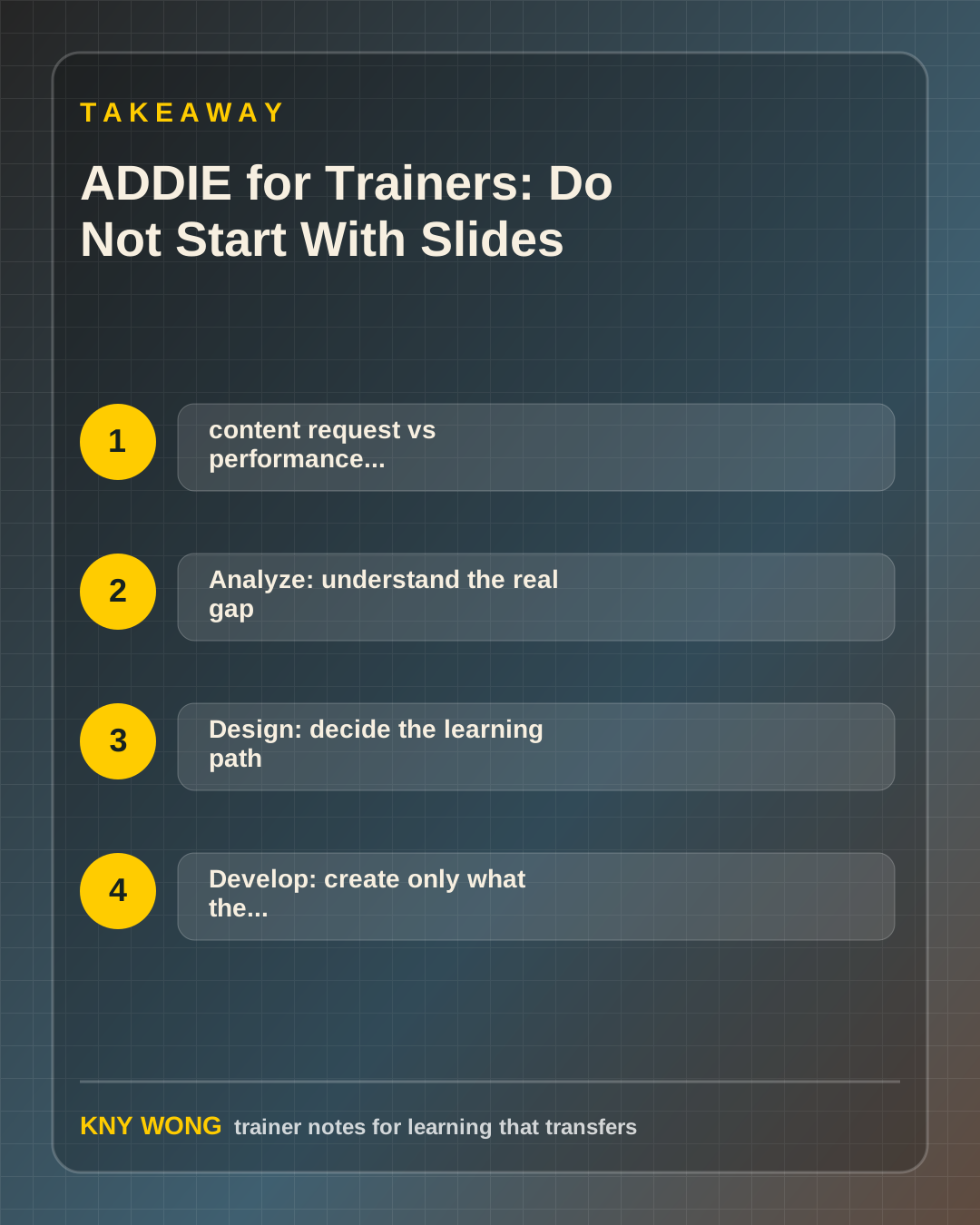
The simple distinction: content request vs performance problem
A content request sounds like:
"We need a communication workshop."
A performance problem sounds like:
"Managers are avoiding difficult conversations, so issues stay unresolved until they become bigger."
Those are not the same.
The first points to a topic.
The second points to a behavior.
ADDIE helps you move from topic to behavior.
Analyze: understand the real gap
The Analyze stage is about clarifying the instructional problem, audience, goals, constraints, and learner starting point.
For a trainer, this means asking:
- Who is in the room?
- What do they do now?
- What should they do differently?
- What makes the change hard?
- What support exists after training?
Do not skip this step.
If analysis is weak, the rest of the design becomes guesswork.
Design: decide the learning path
Design is where you decide the learning objectives, activity flow, assessment approach, and learning sequence.
This is not yet the time to polish slides.
It is the time to decide:
- what learners must practice
- how you will know they can do it
- what examples will make it real
- how the session will move from awareness to application
Good design makes delivery easier.
Develop: create only what the design needs
Development is where materials are created.
Slides, worksheets, forms, learner notes, and facilitator guides belong here.
The mistake is creating too much.
Materials should serve the learning path, not bury it.
If a slide, handout, or activity does not support the objective, remove it.
Implement: prepare the room, not only the trainer
Implementation is the delivery stage.
For facilitators, implementation includes:
- setting up materials
- briefing co-facilitators
- preparing participants
- managing tools
- adapting to the room
Implementation is not just "run the workshop."
It is making sure the designed experience can actually happen.
Evaluate: learn from the training
Evaluation checks whether the training worked.
InstructionalDesign.org notes that ADDIE evaluation includes formative and summative evaluation. In practical terms, that means you check quality while building and after delivery.
For trainers, evaluation should ask:
- Did learners engage?
- Did they learn?
- Did they apply?
- What should be improved next time?
Evaluation should feed the next analysis.
ADDIE is often shown as a sequence, but in practice it should be used with feedback and revision.
Common mistakes to avoid
The first mistake is treating ADDIE as administration.
Used well, it is a thinking tool.
The second mistake is making it too linear.
If you discover during development that the objective is unclear, go back to design.
The third mistake is skipping evaluation.
Without evaluation, every future workshop starts from memory and opinion instead of evidence.
A 15-minute action step
Before building your next deck, write one sentence for each ADDIE stage:
- Analyze: The real problem is...
- Design: The learner must be able to...
- Develop: The materials needed are...
- Implement: The room must be ready for...
- Evaluate: We will know it worked when...
If you cannot complete these five sentences, you are not ready to build slides yet.
Final takeaway
Not to make the work bureaucratic.
To make the training purposeful.
Related reading:
- Bloom's Taxonomy for Trainers: Write Objectives That Drive Action
- Kirkpatrick Model for Trainers and Facilitators
If you want this adapted for your trainers, teams, or facilitation workflow, contact Kny.