
Engagement Is Not the Same as Learning Impact
14 May 2026
A practical, no-sugar-coating guide for trainers and facilitators who want workshop energy to become skill, transfer, and real learning impact.
I like energy in a training room.
I like laughter.
I like movement.
I like when people stand up, talk to each other, and the room feels alive.
But let me say this clearly.
Energy is not the same as impact.
A workshop can be noisy, fun, active, and still change nothing after lunch the next day.
That is the part trainers need to be honest about.
Engagement gets people into the activity.
Impact is what stays after the activity is over.
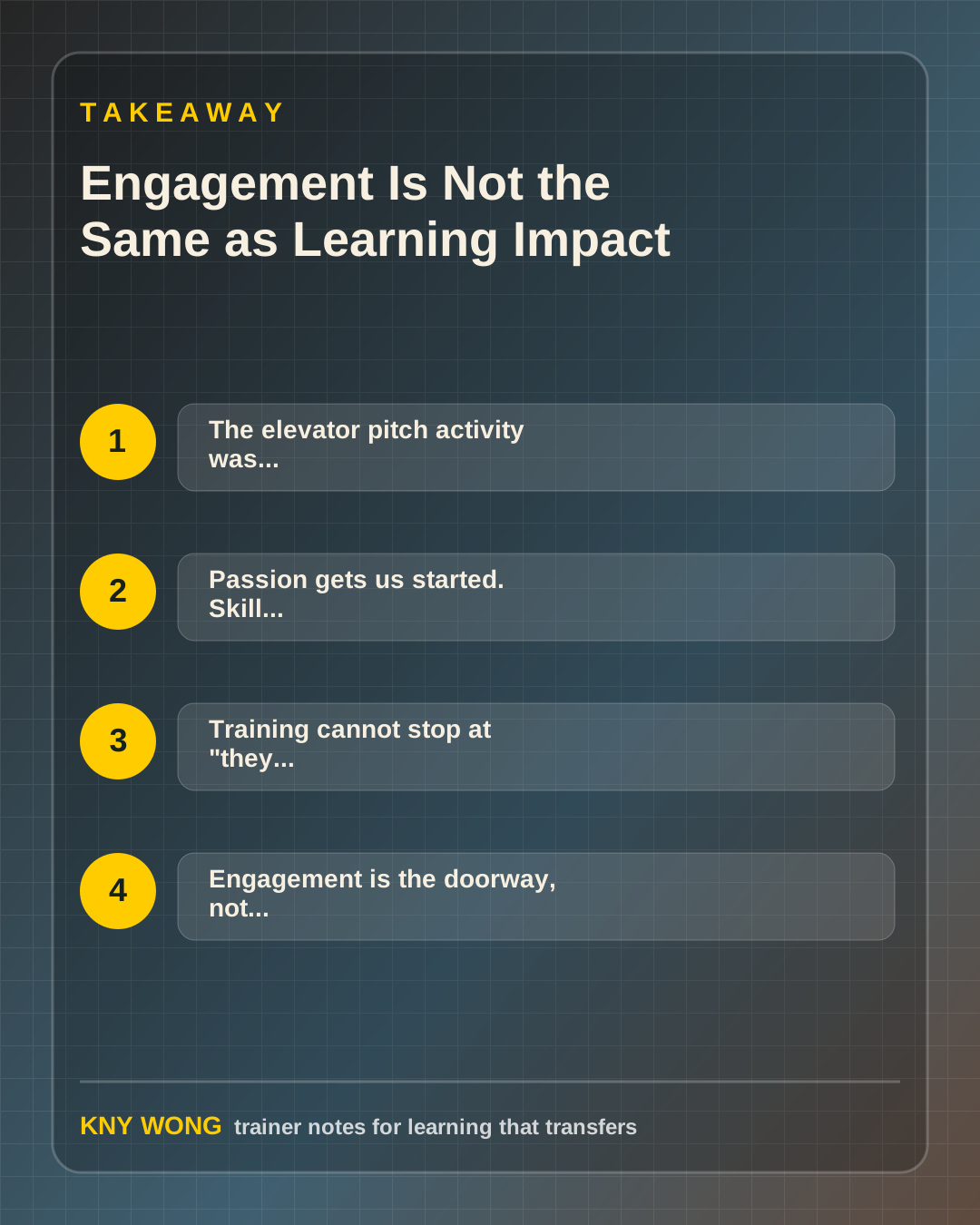
The elevator pitch activity was not really about pitching
One activity I like is simple.
I ask everyone to write an elevator pitch.
Of course, the visible task is to write the pitch.
But the real learning is not the pitch.
The real learning is the debrief.
After they write, I give them one minute to find a partner and pitch to each other.
Then they rotate.
Again.
And again.
Maybe ten times.
By the end, the room is different.
Some people are more energetic. Some people are tired. Some improve their pitch quickly. Some keep repeating the first version even when it no longer works.
Then I ask:
"As you pitched, did you improve from round 1 to round 2?"
"Did you feel more energised as you went, or totally opposite?"
"What changed after the first few rounds?"
That is where the lesson starts.
Not during the writing.
Not even during the pitching.
During the debrief.
Passion gets us started. Skill keeps us moving.
At the start, people are excited because they believe in what they wrote.
They have hope.
They want the pitch to work.
That is passion.
Passion is powerful.
But passion also drops.
After the third or fourth round, the excitement may die off. The sentence that sounded so good at first starts to feel heavy in the mouth. The energy changes.
But something else also happens.
People improve.
They cut words.
They notice where the other person gets confused.
They adjust the opening.
They keep what works.
They stop saying what does not land.
Think about it.
In life and work, passion gets us started.
But skill keeps us moving.
That is the flipchart line.
Passion gets us started. Skill keeps us moving.
That is why engagement alone is not enough.
Engagement may create the first burst.
Learning impact comes when the participant improves, notices, adjusts, and carries the skill forward.
Training cannot stop at "they enjoyed it"
The CDC describes training as an organized activity that helps learners gain knowledge or skills, with the goal of improving competence, capacity, and performance.
That is a useful reminder.
Training is not only about whether people enjoyed the session.
Enjoyment matters.
Nobody wants a dead room.
But if the session is enjoyable and nothing improves, we need to be honest.
It was a good experience.
It may not yet be good training.
The question is not only:
"Were they engaged?"
The better question is:
"What are they now able to do better?"
Engagement is the doorway, not the destination
Engagement helps people enter.
It creates attention.
It lowers resistance.
It gives people a reason to participate.
But engagement must point somewhere.
An activity can be fun but empty.
A discussion can be lively but shallow.
A group challenge can be noisy but disconnected from work.
So before I keep an activity in a workshop, I ask:
"What is this activity really for?"
If the answer is only "to energise the room," okay, maybe it has a place.
But if every activity is only for energy, then we are not designing learning.
We are managing mood.
The impact question changes the design
The Kirkpatrick Model is useful here because it widens the lens.
Kirkpatrick Partners describes four levels: Reaction, Learning, Behavior, and Results.
Reaction asks whether participants found the experience relevant and engaging.
Learning asks whether they gained knowledge, skill, attitude, confidence, or commitment.
Behavior asks whether they apply it in their environment.
Results asks whether the intended outcomes happen.
This does not mean every trainer must run a complicated evaluation project.
But it does mean we should know which level we are designing for.
If we only design for reaction, we may chase smiles.
If we design for learning and behavior, we start asking harder questions.
What should they practise?
What feedback will they receive?
Where will they use this?
What might stop them after the session?
Who needs to support them?
Those questions make the design stronger.
Activity energy vs transfer energy
There are two kinds of energy in training.
Activity energy is what you see in the room.
People talking. Moving. Laughing. Competing. Responding.
Transfer energy is quieter.
It is the moment someone says:
"I can use this with my team."
"I know where I usually get stuck."
"I need to try this conversation differently."
"This is the step I will take next week."
Both matter.
But if I must choose, I will protect transfer energy.
Because that is where impact begins.
A simple activity test
Before using an activity, ask five questions:
- What workplace behaviour does this activity support?
- What skill or decision does the participant practise?
- What feedback will they get?
- What will they notice about themselves?
- What action should continue after the session?
If the activity cannot answer any of these, maybe it is still fun.
But do not pretend it is impact.
No sugar coating.
Fun is fun.
Learning is something else.
Where Accelerated Learning fits
The Center for Accelerated Learning says learning involves the whole mind and body, and that collaboration aids learning.
I agree with that.
People should not only sit and consume.
They should speak, move, reflect, build, test, and create.
But involvement must serve the learning.
Movement without meaning is just movement.
Collaboration without reflection is just talking.
The debrief turns activity into learning.
That is the trainer's work.
A 15-minute action step
Choose one activity you use often.
Write the activity name at the top of a page.
Then answer:
- What is the visible task?
- What is the real lesson?
- What debrief question exposes that lesson?
- What workplace behavior should improve?
- What action should participants take after the session?
If you cannot answer clearly, redesign the activity.
Do not remove energy.
Aim it.
Final takeaway
But energy is not the finish line.
The trainer's job is to turn activity into awareness, awareness into skill, and skill into action.
That is learning impact.
Related reading:
- Accelerated Learning for Trainers: Active, Social, Usable Design
- Kirkpatrick Model for Trainers and Facilitators
If you want this adapted for your trainers, teams, or facilitation workflow, contact Kny.