
Ladder of Inference for Trainers: Slow Down Assumptions
14 May 2026
A practical guide for trainers and facilitators to use the Ladder of Inference to teach reflection, communication, conflict, and decision-making.
In many workshops, the problem is not that people cannot think.
The problem is that they think too quickly.
Someone says one sentence.
Another person hears a tone.
A memory is triggered.
A conclusion appears.
Then the reaction comes out.
"She is not committed."
"He is being difficult."
"They never support us."
The Ladder of Inference helps trainers slow that moment down.
It gives learners a way to examine how they move from observation to action.
Think of it like catching your own mind before it runs down the staircase.
Most conflict does not wait politely for us to check the facts.
The ladder helps us pause before we act on a story we built too quickly.
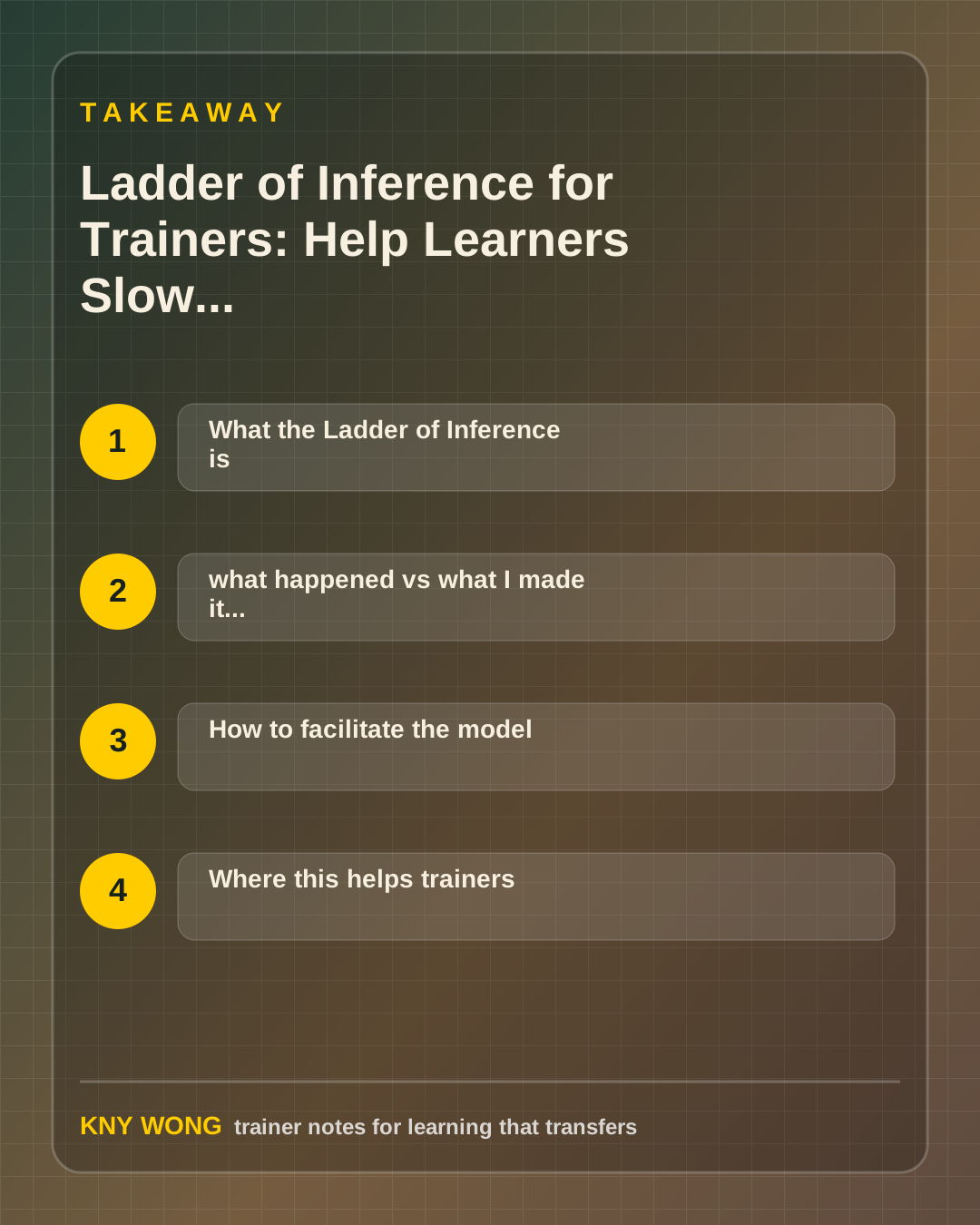
What the Ladder of Inference is
Harvard Business Publishing describes the Ladder of Inference as a model that shows how people move quickly from observations and experiences to assumptions, beliefs, and action.
Harvard's Program on Negotiation describes the model as beginning with observable data and experiences, then moving through selected data, interpretation, conclusions, beliefs, and action.
The model is commonly associated with Chris Argyris and Donald Schon, and is often used in leadership, communication, negotiation, and self-awareness work.
For trainers, its value is simple:
It helps people see the thinking they usually skip.
The simple distinction: what happened vs what I made it mean
This is the heart of the model.
What happened:
"The participant looked at their phone during the activity."
What I made it mean:
"They are disengaged."
That conclusion might be true.
It might also be wrong.
Maybe they were checking a work emergency.
Maybe they were translating a term.
Maybe they were taking notes.
The Ladder of Inference does not tell learners to stop making meaning.
It teaches them to check the meaning before acting on it.
How to facilitate the model
Use a real but low-risk scenario.
For example:
"Your colleague does not respond to your message for two days."
Ask learners to separate:
- Observable data
- Selected data
- Interpretation
- Assumption
- Conclusion
- Action
Then ask:
- "Where could another explanation exist?"
In that space, better communication becomes possible.
Where this helps trainers
The Ladder of Inference fits well in:
- conflict management
- feedback conversations
- leadership training
- psychological safety sessions
- coaching skills
- cross-functional collaboration
- facilitation debriefs
It is especially useful when learners need to notice their own thinking, not only learn a communication technique.
Common mistakes to avoid
The first mistake is teaching the ladder as theory only.
People understand it through examples.
The second mistake is using emotionally heavy cases too early.
Start with safe scenarios before moving to personal workplace conflict.
The third mistake is making people feel blamed for having assumptions.
The point is not shame.
The point is awareness.
Everyone climbs the ladder.
The skill is learning when to climb down.
A 15-minute action step
Ask participants to write one recent workplace conclusion they formed quickly.
Then ask them to answer:
- What did I actually observe?
- What did I select or focus on?
- What meaning did I add?
- What other meaning could be possible?
- What question could I ask before acting?
This turns the model into a communication habit.
Final takeaway
That is where many communication breakthroughs begin.
Sources referenced:
- Harvard Business Publishing: ladder of inference overview
- Program on Negotiation at Harvard: ladder resource list
Related reading:
- Bloom's Taxonomy for Trainers: Write Objectives That Drive Action
- Prompt Thinking Is Facilitation Thinking
If you want this adapted for your trainers, teams, or facilitation workflow, contact Kny.