
Prompt Thinking Is Facilitation Thinking
14 May 2026
A practical article for trainers and facilitators on why prompting is not about clever commands, but about context, criteria, distinction, and impact.
Most people think prompting is about typing better sentences.
Use this formula.
Add this magic phrase.
Tell AI to act like an expert.
Then the output becomes amazing.
Sorry, no.
That is too shallow.
Prompting is not only about the words you type.
Prompting is about the thinking behind the words.
And for trainers and facilitators, that is good news.
Because prompting is very close to facilitation.
You frame the task.
You set the context.
You clarify the audience.
You define success.
You ask better questions.
You decide what needs checking.
That is not a tech trick.
That is facilitation thinking.
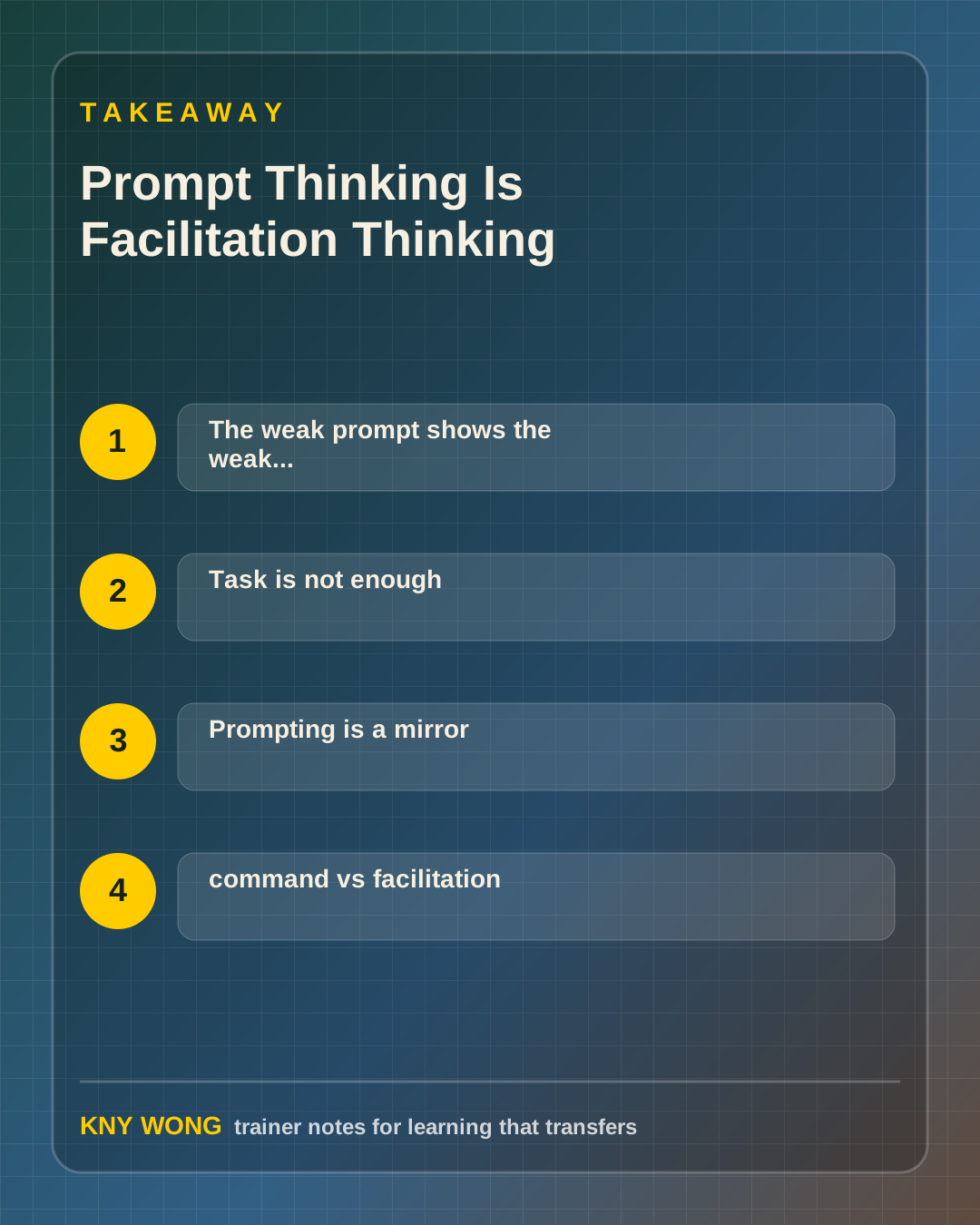
The weak prompt shows the weak thinking
When someone writes:
"Create a training plan."
The problem is not only that the prompt is short.
The deeper problem is that the work is unclear.
Training for whom?
For what problem?
For what outcome?
In what context?
What should participants be able to do?
What should the trainer avoid?
What will make the plan useful?
If the person cannot answer those questions, AI will still answer.
That is the dangerous part.
AI will produce something even when the thinking is not ready.
It may sound confident.
It may look complete.
But complete does not mean useful.
Task is not enough
In my prompting sessions, I use a 10-element frame.
But I always spend time on distinction work.
Especially Task and Impact.
Because most people come to AI with a task.
"Write this."
"Summarise this."
"Create this."
"Make this faster."
Nothing wrong with that.
But look forward.
Every year, new graduates enter the workforce.
If the comparison is only speed, efficiency, and technology savviness, do you really think they will lose?
If I am a business owner and I only need someone to complete a task, the answer becomes very clear.
So what is your value?
Think about it.
You have gone through work.
You have handled difficult people.
You have seen projects fail.
You have made mistakes.
You know what looks simple on paper but becomes messy in real life.
That experience is not nothing.
AI can help complete the task.
Your value is making sure the task creates the right impact.
That is the distinction.
Prompting is a mirror
A prompt shows how clearly you understand the work.
If the task is vague, the prompt becomes vague.
If the audience is unclear, the answer becomes generic.
If the impact is missing, the output becomes completion without contribution.
This is why prompt training should not only teach templates.
Templates help.
But templates cannot replace thinking.
A strong prompt is not strong because it is long.
It is strong because the work has been framed properly.
The simple distinction: command vs facilitation
A command says:
"Write an email."
A facilitated prompt says:
"Help me write a short follow-up email for managers who attended a difficult-conversation workshop. The goal is not to thank them only, but to remind them to practise one conversation this week. Keep the tone practical, respectful, and not too corporate. Ask me two questions before drafting."
See the difference?
The second prompt is not just more detailed.
It is better facilitated.
It has context.
It has audience.
It has intention.
It has tone.
It has interaction.
It has impact.
That is why trainers are well placed to teach prompting.
We already know how to frame a room.
Now we need to frame the work with AI.
AI literacy is not button literacy
UNESCO's AI competency framework for teachers includes areas such as a human-centred mindset, ethics of AI, AI foundations and applications, AI pedagogy, and AI for professional learning.
That tells us something important.
AI literacy is not only knowing which button to click.
It includes judgment.
It includes ethics.
It includes knowing when to use AI, when not to use AI, and how to stay responsible for the output.
For workplace trainers, this matters.
If we teach AI only as a productivity shortcut, participants may become faster at producing weak work.
No thanks.
The goal is not faster nonsense.
The goal is better thinking, better output, and better impact.
A practical prompt-thinking frame
Use this as a thinking scaffold:
- Task - What do you want AI to help produce?
- Impact - What should this output change, support, or improve?
- Audience - Who is this for?
- Context - What background matters?
- Criteria - What does good look like?
- Constraints - What must AI avoid?
- Interaction - Should AI ask, draft, critique, compare, or revise?
This is not the full 10-element frame.
It is the part most people need first.
Because once Task and Impact are clear, the rest becomes easier.
How to facilitate prompt practice
Do not only give participants a prompt template.
Let them feel the difference.
Try this:
- Ask participants to write a prompt for a real task.
- Let AI answer.
- Ask them to judge the output.
- Introduce Task vs Impact.
- Ask them to rewrite the prompt.
- Compare the second output with the first.
- Debrief what changed in their thinking.
The learning is not that the second prompt is longer.
The learning is that clearer thinking creates better AI work.
Common mistakes to avoid
The first mistake is worshipping prompts.
A prompt is a tool, not a religion.
The second mistake is teaching people to copy without understanding.
That creates dependency, not skill.
The third mistake is stopping at task completion.
If the output does not create value for someone, the work is incomplete.
The fourth mistake is accepting the first answer because it sounds polished.
Polished is not the same as correct.
Polished is not the same as useful.
Polished is not the same as impact.
A 15-minute action step
Take one task you normally use AI for.
Write your usual prompt.
Then add only one thing:
Impact.
Complete this sentence:
"The output should help the other person..."
Then rewrite the prompt.
Compare the output.
You may notice something uncomfortable.
AI was not the only one that needed better instructions.
We needed clearer thinking.
Final takeaway
Prompting is how clearly you frame the work.
AI can help complete the task. Your value is making sure the task creates impact.
That is why prompt thinking belongs in the hands of trainers and facilitators.
Sources referenced:
- UNESCO: AI competency framework for teachers
- UNESCO: competency framework collection
- CDC training development overview
Related reading:
If you want this adapted for your trainers, teams, or facilitation workflow, contact Kny.