Fix Weak AI Prompts With a 10-Element Framework
13 May 2026
A practical guide to the T.I.C.E.A.R.S.T.F.L. framework and why complete prompts produce better workplace AI outputs.
By Kny Wong | AI Literacy Trainer & Facilitator | knywong.com
Most professionals in Malaysia and across Southeast Asia are already using AI tools like ChatGPT, Gemini, or Copilot at work. But most are getting mediocre results — not because the AI is bad, but because the prompt is incomplete. The fix is a structured prompting framework called T.I.C.E.A.R.S.T.F.L., the backbone of the *Turning Prompt Into Impact* workshop. This article explains what it is, why it works, and how you can apply it today.
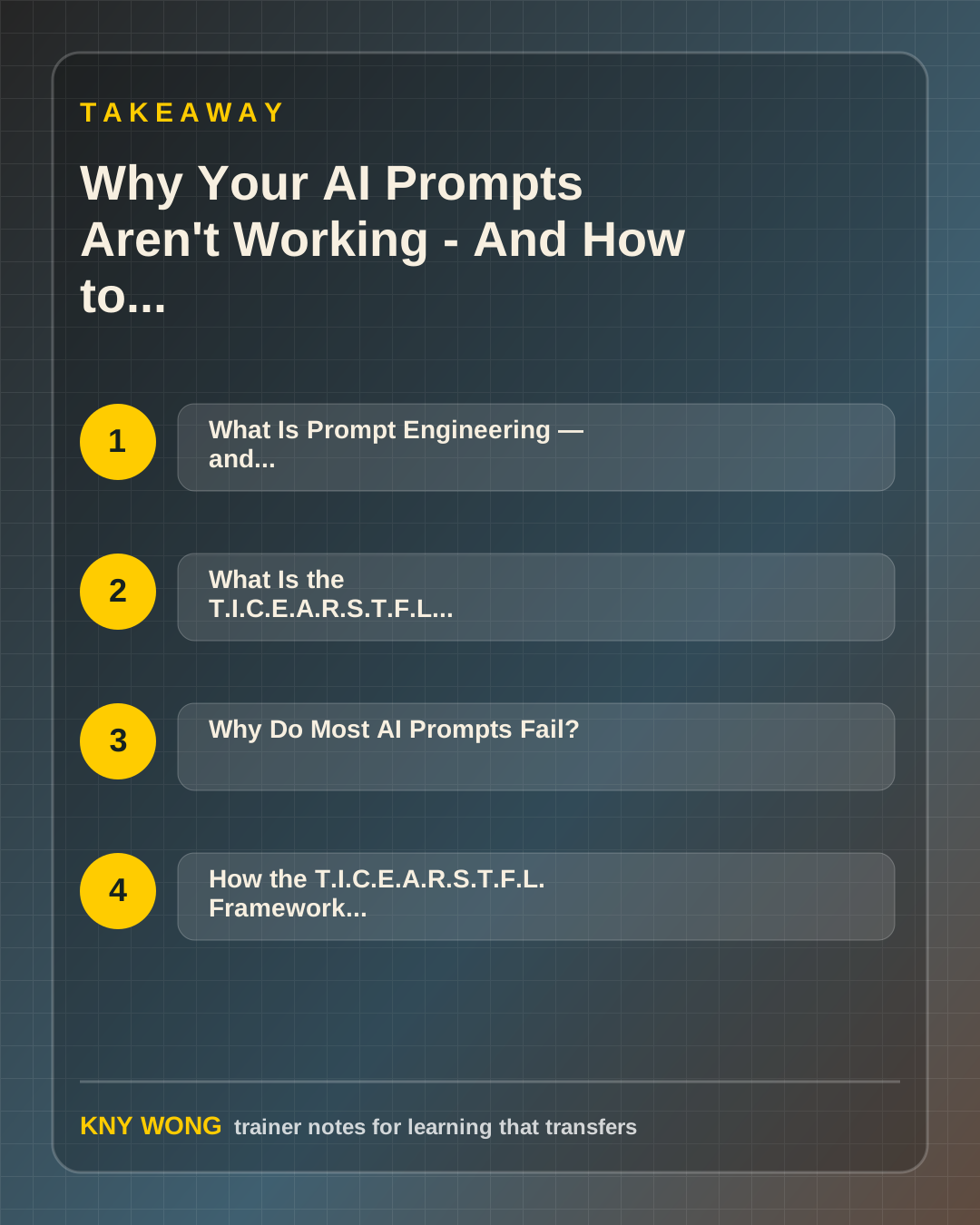
What Is Prompt Engineering — and Why Does It Matter at Work?
Prompt engineering is the practice of crafting inputs to an AI system in a way that produces accurate, useful, and relevant outputs. It is not about using magic words. It is about giving the AI the right information in the right structure.
In a corporate setting, poor prompting wastes time and erodes trust in AI. A well-engineered prompt, by contrast, acts like a clear brief to a skilled assistant — and that is exactly what the T.I.C.E.A.R.S.T.F.L. framework is designed to deliver.
What Is the T.I.C.E.A.R.S.T.F.L. Framework?
The T.I.C.E.A.R.S.T.F.L. framework is a 10-element prompting structure developed for corporate AI literacy training. It organises every element a complete AI prompt needs into three layers: what the human brings in, how to frame the AI, and what the output should look like.
The 10 elements are:
- T — Task: What do you want the AI to do?
- I — Impact: What is the purpose or goal of this output?
- C — Context & Content: What background does the AI need to know?
- E — Examples: What good looks like (or what to avoid)
- A — AI Role: What role or persona should the AI take on?
- R — AI Experience: What relevant expertise should the AI draw from?
- S — Success Measure: How will you know the output is good?
- T — Tone & Style: What voice or register should the response use?
- F — Format & Structure: How should the output be organised?
- L — Language: Which language should the AI respond in?
These 10 elements are grouped into three design layers:
| Layer | Elements | Purpose |
|---|---|---|
| Human Input | Task, Impact, Context & Content, Examples | What you bring to the prompt |
| AI Framing | AI Role, AI Experience, Success Measure | How you configure the AI |
| Output Design | Tone & Style, Format & Structure, Language | What the output looks and sounds like |
Why Do Most AI Prompts Fail?
Most AI prompts fail because they only contain one or two elements — usually just the Task. Without the other nine elements, the AI has to guess. And when AI guesses, it defaults to generic.
Common signs of an incomplete prompt:
- The output sounds like it was written for no one in particular
- The AI missed important context you assumed it knew
- The response is in the wrong format for your use case
- The tone is too formal, too casual, or simply off-brand
The T.I.C.E.A.R.S.T.F.L. framework eliminates this guesswork by making every design decision in a prompt explicit.
How the T.I.C.E.A.R.S.T.F.L. Framework Works in Practice
Here is a real example, comparing a vague prompt to a complete one.
Vague Prompt
*"Write an email to my team about the new policy."*
Complete Prompt Using the Framework
Task: Write an internal email announcing a new flexible working policy. Impact: To inform staff and reduce anxiety about the change before the town hall. Context: We are a 200-person financial services firm in KL. The policy takes effect 1 August. Examples: Tone similar to previous update emails — warm but professional. AI Role: Act as an internal communications specialist. AI Experience: Draw from change communication best practices. Success Measure: Staff should feel informed and reassured, not alarmed. Tone & Style: Warm, clear, conversational. Avoid jargon. Format: Short intro paragraph, three bullet points, a closing call to action. Language: English, with a brief Bahasa Malaysia note at the end.
The difference in output quality is significant. The first prompt produces a template. The second produces communication that fits the real situation.
What Is the "Turning Prompt Into Impact" Workshop?
*Turning Prompt Into Impact* is a full-day AI literacy workshop designed for corporate teams across industries. It is facilitated by Kny Wong, an AI literacy trainer based in Malaysia with over 48 AI training sessions delivered across 26+ organisations including Schneider Electric, HSBC, Shell SBO, and Intel.
The workshop is built around the T.I.C.E.A.R.S.T.F.L. framework and takes a hands-on, experiential approach — participants do not sit through slides. They discover how incomplete prompts fail, then build towards complete ones through guided practice.
What participants leave with:
- A working understanding of all 10 prompt elements and when to use each
- Hands-on practice writing full, structured prompts in their own work context
- A personal prompt template they can apply from day one
- Awareness of when AI can and cannot be trusted (a critical skill for professional use)
The workshop is available in English, Bahasa Malaysia, and Mandarin, and can be adapted for half-day or in-house formats.
Who Is This Workshop For?
The *Turning Prompt Into Impact* workshop is designed for:
- Corporate teams rolling out AI tools who need staff to use them effectively and safely
- Managers and executives who use AI for drafting, analysis, or communication
- L&D and HR professionals building internal AI capability programmes
- Knowledge workers in finance, manufacturing, consulting, healthcare, and professional services
It is not a technical course. No coding or IT background is required. The focus is practical: how to get better results from AI tools you are already using.
What Makes Experiential AI Training More Effective Than a Lecture?
Experiential AI training works because it puts learners in situations where they feel the difference between a weak prompt and a strong one — before they are told what makes one better.
Research in adult learning consistently shows that people retain knowledge better when they experience a problem first, then receive the framework to solve it. In the *Turning Prompt Into Impact* workshop, this is the design principle behind every activity: experience before explanation.
This approach — rooted in accelerated learning methodology — means participants are not just informed about the T.I.C.E.A.R.S.T.F.L. framework. They build an intuition for it through practice, which is what makes it stick when they return to work.
Can the T.I.C.E.A.R.S.T.F.L. Framework Be Applied in Any Industry?
Yes. The framework is industry-agnostic because its structure is based on what every AI output needs — regardless of whether the user is writing a compliance report, a sales deck, a customer email, or a policy brief.
Across industries, the same pattern holds: the more context, intent, and output design you give an AI, the better the result. The 10-element framework makes that process systematic rather than accidental.
How to Get Started With Better Prompting — Without a Workshop
If you want to start improving your prompts today, begin with these three elements before anything else:
- Task + Impact: State what you want and why. *"Summarise this report [Task] so I can brief my director in five minutes [Impact]."*
- Context: Add what the AI needs to know that it cannot infer. *"The audience is non-technical. The report is about Q1 manufacturing costs in Malaysia."*
- Format: Specify how you want the output structured. *"Use three short paragraphs with a recommended action at the end."*
These three elements alone will produce noticeably better outputs. The full 10-element framework turns good prompts into consistently excellent ones.
Frequently Asked Questions About AI Prompt Engineering
What is a prompt in AI?
A prompt is the input you give an AI system — the instruction, question, or request that tells it what to do. The quality of your prompt directly determines the quality of the AI's output.
What is prompt engineering?
Prompt engineering is the practice of designing prompts intentionally to get accurate, useful, and relevant outputs from AI systems. It involves structuring your input with the right context, intent, role framing, and output specifications.
What is the T.I.C.E.A.R.S.T.F.L. framework?
T.I.C.E.A.R.S.T.F.L. is a 10-element prompting framework that stands for Task, Impact, Context & Content, Examples, AI Role, AI Experience, Success Measure, Tone & Style, Format & Structure, and Language. It is used in the *Turning Prompt Into Impact* workshop to help corporate teams write more complete, effective AI prompts.
Why do complete prompts produce better AI outputs?
AI models generate responses based on the information provided. When a prompt is incomplete, the model fills in gaps with default assumptions — which often do not match your actual needs. A complete prompt reduces guessing and aligns the AI's output with your specific context and goals.
How long does it take to learn prompt engineering?
Basic prompt improvement can happen in under an hour of structured practice. Full fluency — the ability to consistently write effective prompts across different tasks and contexts — typically develops over a few weeks of deliberate application. The *Turning Prompt Into Impact* full-day workshop is designed to accelerate this learning through hands-on experiential practice.
Is prompt engineering relevant for non-technical professionals?
Yes. Prompt engineering for workplace productivity does not require coding knowledge or technical background. The T.I.C.E.A.R.S.T.F.L. framework is specifically designed for business professionals — managers, communicators, analysts, and team leaders — who use AI tools as part of their daily work.
What AI tools does this framework apply to?
The framework applies to any large language model (LLM) used in a text-based interface, including ChatGPT (OpenAI), Gemini (Google), Copilot (Microsoft), Claude (Anthropic), and similar tools. The underlying principles are consistent across platforms.
How do I bring this workshop to my organisation?
Contact Kny Wong at knywong.com to discuss in-house delivery, programme customisation, and scheduling. The workshop is available in English, Bahasa Malaysia, and Mandarin and can be adapted for half-day formats or integrated into a broader AI capability-building programme.
About the Author
Kny Wong is an AI literacy trainer, facilitator, and coach based in Malaysia. Since 2024, Kny has delivered over 48 AI training sessions across 26+ organisations including Schneider Electric, HSBC, Shell SBO, Intel, BASF Petronas, and Hong Leong Bank. Kny's approach combines experiential learning methodology with practical AI application, with workshops available in English, Bahasa Malaysia, and Mandarin. Learn more at knywong.com.
*Tags: prompt engineering, AI literacy, corporate AI training, workplace AI, ChatGPT training, AI for business, T.I.C.E.A.R.S.T.F.L. framework, AI upskilling Malaysia, generative AI training*
Sources referenced:
- UNESCO AI competency framework for teachers
- CDC training development overview
- Center for Accelerated Learning guiding principles
Related reading: