
Why AI Training Needs Trainers, Not Tool Demonstrators
14 May 2026
A practical argument for why AI training needs facilitation, practice, ethics, and impact - not just tool demonstrations.
AI training can easily become a magic show.
Open the tool.
Type a prompt.
The answer appears.
Everyone says, "Wah, so fast."
Then what?
That is the question.
If the participant goes back to work and still cannot decide when to trust the output, how to improve it, what to protect, or what impact the work should create, then the demo has not done enough.
It may be impressive.
But impressive is not the same as useful.
AI training needs trainers because the real work is not showing what AI can do.
The real work is helping people think, practise, check, adapt, and apply.
We have seen this story before
People say AI will replace us.
Maybe some parts of work will be replaced.
Let's not sugar coat.
Replacement happens.
But this is not the first time people felt that technology would change everything.
When Google Search became normal, knowledge became easier to access.
When YouTube became normal, people could learn almost anything from videos.
When TikTok became normal, short-form explanation changed how people discover ideas.
Did everyone get replaced?
No.
Did some people lose relevance because they refused to adapt?
Yes.
But here is the deeper point.
Adapting is not enough.
Many people adapt to tools.
The people who keep creating value are the ones who do work that creates impact.
That is where trainers come in.
Tool demonstration answers the smallest question
A tool demonstration answers:
"What can this thing do?"
Training answers:
"What can this person now do better, more responsibly, and with more impact because of the learning?"
That is a very different question.
The CDC describes training as an organized activity that helps learners gain knowledge or skills, with the goal of improving competence, capacity, and performance.
So if an AI session only produces excitement, it has not reached the full job of training.
It has created reaction.
It has not necessarily created competence.
The trainer designs the practice
In weak AI training, participants watch.
In stronger AI training, participants practise.
They write prompts.
They compare outputs.
They identify what is missing.
They check for hallucination.
They ask what the output will be used for.
They revise.
They discuss risk.
They connect the work back to their job.
That is where the trainer matters.
The trainer is not there to show off.
The trainer is there to create the conditions where people can learn.
AI changes the trainer's role, not the need for trainers
UNESCO's AI Competency Framework for Teachers says AI has shifted the traditional teacher-student relationship into a teacher-AI-student dynamic. It also identifies areas such as a human-centred mindset, ethics of AI, AI foundations and applications, AI pedagogy, and AI for professional learning.
Even though the framework is written for teachers, the lesson is relevant for workplace trainers.
AI adds a new actor into the room.
That does not remove the trainer.
It changes what the trainer must pay attention to.
Someone still needs to ask:
- What is the learning goal?
- What is the workplace task?
- What impact should the output create?
- What should not be automated?
- What does responsible use look like?
- What must the human still check?
AI can produce answers.
It cannot carry your responsibility.
Activity is not the point. Debrief is the point.
This is why AI training cannot be only tool practice.
The practice matters, yes.
But the debrief matters more.
After participants use AI, ask:
- What improved?
- What became worse?
- What did AI assume?
- What did you forget to tell it?
- What would happen if you sent this output as-is?
- Who would be affected?
- What impact should this task create?
That is where people start building judgment.
Without the debrief, AI practice becomes button pressing.
With the debrief, it becomes learning.
The real issue is not AI replacing people
The easy fear is:
"AI will replace me."
The better question is:
"If AI can complete some of my tasks, what value do I bring?"
For experienced professionals, the answer should not only be speed.
New graduates will keep entering the workforce.
Some will be faster.
Some will be more comfortable with tools.
Some will adapt very quickly.
So if your value is only "I can complete the task," you are in trouble.
But if your value is judgment, context, relationship, ethics, and impact, then AI becomes part of your work, not the whole of your value.
That is the message trainers need to help people face.
No panic.
No fairy tale.
Just honest work.
What trainers add to AI learning
Trainers add diagnosis.
They help people find the real problem before choosing the tool.
Trainers add structure.
They turn vague curiosity into a learning path.
Trainers add practice.
They let participants try, fail safely, compare, and improve.
Trainers add ethics.
They keep privacy, accuracy, bias, and accountability in the room.
Trainers add transfer.
They help participants decide what to do when they return to work.
That is why AI training needs trainers.
Not tool demonstrators.
A better design question
Do not begin an AI workshop by asking:
"Which tool should I show?"
Begin with:
"What work do participants need to do better?"
Then ask:
- What does a good output look like?
- What does a bad output look like?
- Where can AI help?
- Where can AI mislead?
- What human judgment is required?
- What impact should this task create?
Now you are designing training.
Not a demo.
A 15-minute action step
Take one AI demo you usually run.
Add a debrief.
Use these questions:
- What did AI do well?
- What did AI miss?
- What did you have to clarify?
- What would be risky if you used this immediately?
- What impact should this output create for the other person?
That small shift changes the session.
The tool is still there.
But now the human learning is visible.
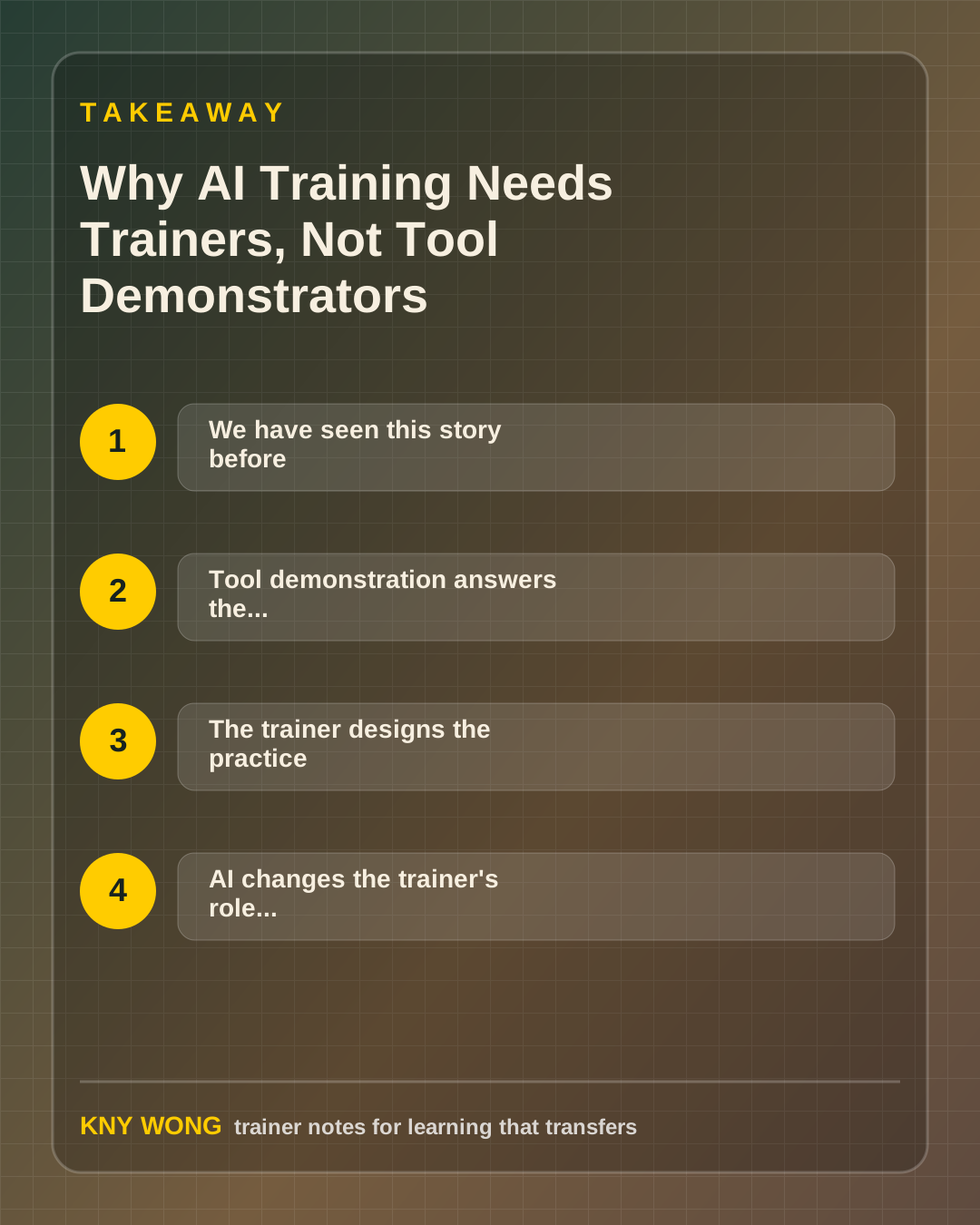
Final takeaway
It raises the standard.
Anyone can show a tool. Trainers help people practise judgment, create impact, and carry the learning back to work.
Sources referenced:
- UNESCO AI competency framework for teachers
- CDC training development overview
- Center for Accelerated Learning overview
Related reading:
If you want this adapted for your trainers, teams, or facilitation workflow, contact Kny.