
Accelerated Learning in the AI Training Room
14 May 2026
A practical article on how Accelerated Learning keeps AI training active, human, collaborative, and focused on what learners can actually use.
AI can make trainers lazy if we are not careful.
Not because trainers are bad.
Because the tool is fast.
You ask for an activity, AI gives one.
You ask for a slide outline, AI gives one.
You ask for a quiz, AI gives one.
Everything looks ready.
But ready is not the same as right.
And fast is not the same as learned.
That is why Accelerated Learning matters in the AI training room.
It reminds us that learners must do something with the learning.
They must create, compare, reflect, discuss, practise, and improve.
If AI only helps us produce more material for people to consume, then we have missed the point.
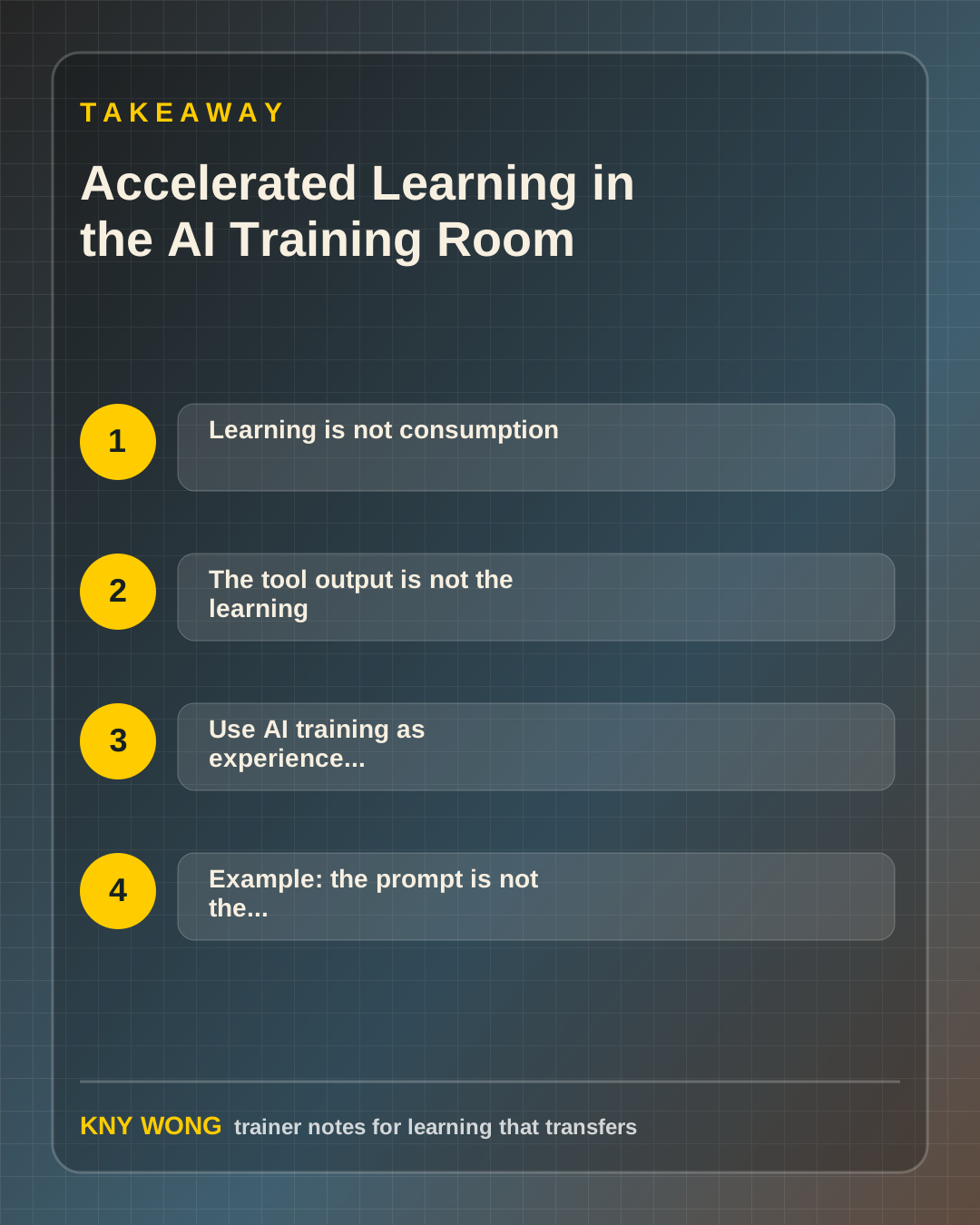
Learning is not consumption
The Center for Accelerated Learning describes learning as creation, not consumption. It also emphasizes collaboration and whole mind-body involvement.
Its overview page is also useful for context on where this approach came from and why it still matters.
That is a very important idea for AI training.
Because AI can produce content so quickly that we may accidentally turn the workshop into a content buffet.
More examples.
More prompts.
More templates.
More slides.
More handouts.
But participants do not learn just because we give them more things.
Sometimes more content only creates more fog.
The question is:
"What will learners create with this?"
That question changes the design.
The tool output is not the learning
In AI training, people often focus on the output.
"Look at this email."
"Look at this proposal."
"Look at this summary."
Fine.
But the output is only part of the learning.
The real learning is in the process:
- What did you ask?
- What context did you provide?
- What did AI miss?
- What did you accept too quickly?
- What did you improve?
- What judgment did you apply?
No debrief, no depth.
The output may look good, but the participant may not know why it worked.
That means they cannot repeat the thinking when the situation changes.
Use AI training as experience, not lecture
Kolb's Experiential Learning Cycle describes learning as knowledge created through transforming experience. It is commonly represented through concrete experience, reflective observation, abstract conceptualization, and active experimentation.
For AI training, this is very useful.
Use this flow:
- Try
Let participants use AI on a realistic workplace task.
- Notice
Ask what happened. What worked? What felt wrong? What was missing?
- Name
Introduce the principle, distinction, or framework.
- Try again
Let them improve the prompt, process, or output.
That is simple.
But it is powerful.
Because people do not only hear the concept.
They feel the difference.
Example: the prompt is not the point
Imagine you are teaching participants to use AI for workplace communication.
The weak way is to show a "perfect prompt" and ask everyone to copy.
The stronger way is to let them write a weak prompt first.
Let AI respond.
Then ask:
- "Would you send this to your boss?"
- "Would you send this to your team?"
- "What sounds too generic?"
- "What impact should this message create?"
Now when they rewrite the prompt, they understand why the second version is stronger.
That is Accelerated Learning in action.
The learner creates meaning.
Not just output.
Keep the room human-centred
UNESCO's AI Competency Framework for Teachers includes a human-centred mindset, ethics of AI, AI foundations and applications, AI pedagogy, and AI for professional learning.
For workplace trainers, this is a strong reminder.
AI training should not teach people to surrender their judgment.
It should make judgment stronger.
Ask:
- What decision is AI supporting?
- What should the human still own?
- Who is affected by this output?
- What could go wrong if this is used without checking?
- What values or constraints matter here?
That is not "extra theory."
That is responsible practice.
The trainer becomes designer of conditions
In AI training, the trainer does not need to be the only source of answers.
The room has AI.
The participants have experience.
The trainer's job is to design the conditions for learning.
That means:
- choosing relevant tasks
- creating safe practice
- structuring comparison
- asking sharp debrief questions
- helping participants name the principle
- connecting the lesson back to work
The trainer is not less important.
The trainer is important in a different way.
Common mistakes to avoid
The first mistake is over-demonstrating.
If the trainer uses AI more than the participants do, the room is too passive.
The second mistake is giving too many prompts.
Too many prompts can make people dependent.
The third mistake is skipping reflection.
Without reflection, participants may know what to type but not what to think.
The fourth mistake is treating speed as the win.
Speed is useful.
But if speed produces careless work, it is not improvement.
A 15-minute action step
Take one AI activity you already use.
Add four moments:
- Try
- Notice
- Name
- Try again
Then ask yourself:
"Where does the learner create meaning?"
If the answer is "mostly when I explain," redesign it.
The learner needs to do the work.
Final takeaway
Accelerated Learning helps make it deeper.
The output is not the learning. The learning happens when participants try, notice, name the principle, and try again with better judgment.
Related reading:
If you want this adapted for your trainers, teams, or facilitation workflow, contact Kny.