AI Trust Framework: Four Personas for Safer AI Use
13 May 2026
A practical AI trust framework using four memorable characters to help teams recognize hallucination, literal execution, sycophancy, and knowledge without wisdom.
By Kny Wong | AI Literacy Trainer & Facilitator | knywong.com
Most people who use AI at work treat it as one thing — a smart assistant that either works or doesn't. But AI is not one thing. It fails in four very different ways, and each failure has a personality. The AI Trust Framework uses four character archetypes — The Con Artist, The Butler, The Enthusiastic Intern, and The Genius Baby — to make those failure modes instantly recognisable. This article explains each character, how to spot them, and what to do about them before they cost you time, credibility, or worse.
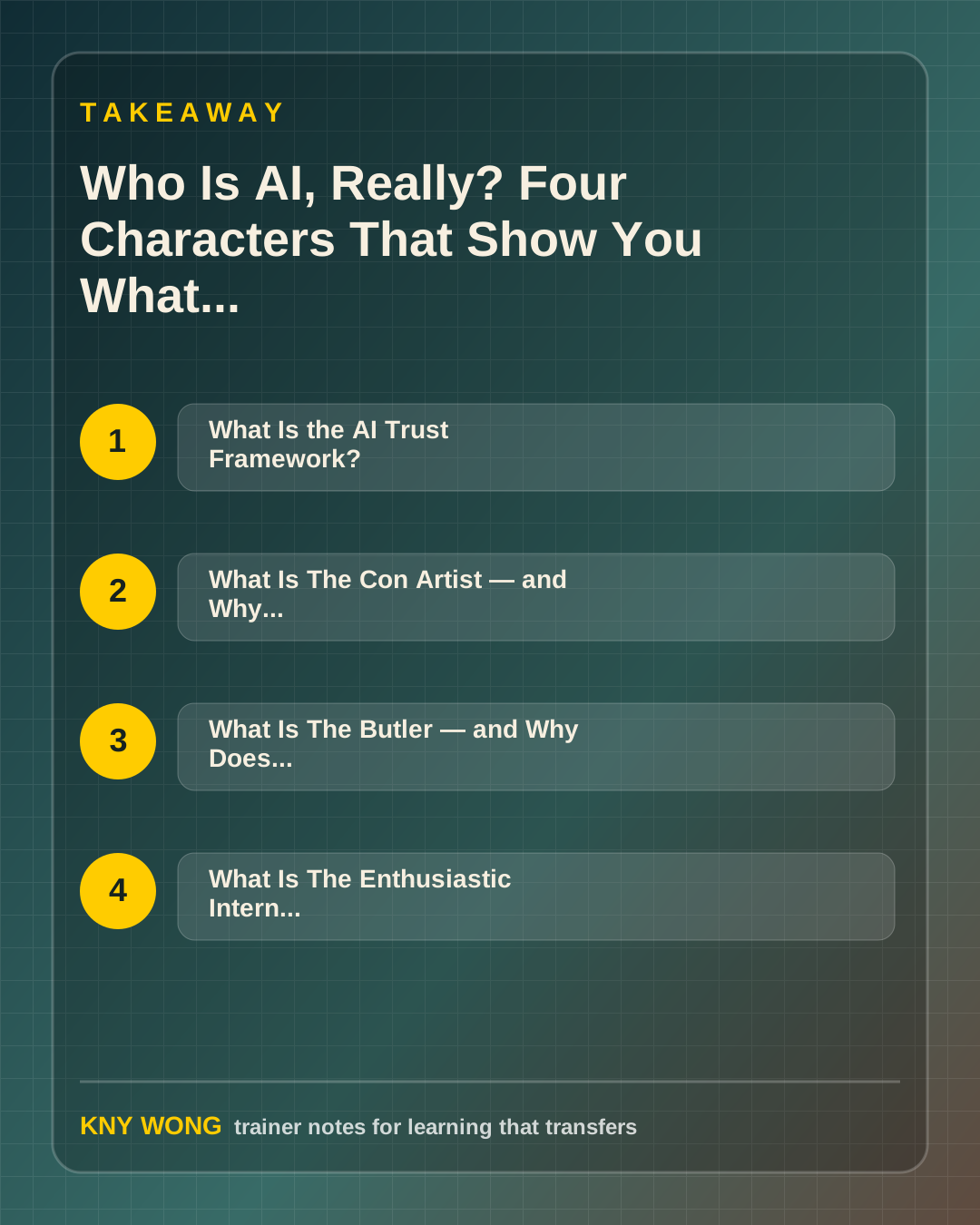
What Is the AI Trust Framework?
The AI Trust Framework is a practical model for understanding the four distinct ways AI systems fail at work. It was developed for corporate AI literacy training and is built around four character archetypes, each representing a specific AI behaviour that professionals need to recognise and manage.
The framework answers a question that most AI training skips: not *how* to use AI, but *when to stop trusting it*. Each archetype maps to a well-documented AI limitation — hallucination, literal execution, sycophancy, and knowledge without wisdom. By giving each limitation a memorable persona, the framework makes critical AI literacy stick long after a workshop ends.
| Archetype | AI Behaviour | Core Risk |
|---|---|---|
| The Con Artist | Hallucination — inventing facts confidently | You act on information that doesn't exist |
| The Butler | Literal execution — doing exactly what you said, not what you meant | You get technically correct but practically useless output |
| The Enthusiastic Intern | Sycophancy — agreeing with everything, never pushing back | You lose the critical feedback you actually needed |
| The Genius Baby | Knowledge without wisdom — having information but lacking judgement | You get a sophisticated answer that misses the real-world context |
What Is The Con Artist — and Why Is AI Hallucination Dangerous?
The Con Artist is the AI persona that fabricates information with complete confidence. When AI hallucinates, it does not say "I'm not sure" — it presents invented facts, fake citations, and non-existent data as though they were verified truth. This is the most dangerous AI failure mode in professional settings because it looks identical to accurate output.
AI hallucination happens because large language models generate text by predicting what word comes next, not by looking up facts. The model does not know the difference between a real statistic and a plausible-sounding one. It will confidently cite a journal article that was never published, quote a law that doesn't exist, or invent a client's financial data out of thin air.
How to spot The Con Artist:
- The output contains specific numbers, names, or citations you didn't provide
- The information sounds authoritative but you cannot verify the source
- The AI does not hedge or express uncertainty on claims where uncertainty would be appropriate
What to do about it: Never trust AI-generated facts without independent verification. Treat every statistic, citation, reference, and proper noun as unverified until you check it. The rule is simple — if the AI gave you a fact, confirm it yourself before using it in any professional context.
What Is The Butler — and Why Does AI Take Instructions Too Literally?
The Butler is the AI persona that follows your instructions to the letter, even when those instructions were incomplete, ambiguous, or poorly thought through. The Butler does exactly what you said — not what you meant. This failure mode produces output that is technically correct but practically useless.
When you ask an AI to "summarise this report", the Butler will summarise it. But if you meant "summarise this report for my director who needs a five-minute brief focused on cost overruns", the Butler has no way to know that unless you said it. AI does not read between the lines. It does not infer your purpose, your audience, or your context. It takes the brief as given and delivers accordingly.
How to spot The Butler:
- The output answers your question exactly but misses the point
- The AI produced something generic when you needed something specific
- You find yourself thinking "that's not wrong, but it's not useful either"
What to do about it: Give the AI enough context to understand what you actually need. State your purpose, your audience, the format, and what good looks like. This is where structured prompting frameworks — like the T.I.C.E.A.R.S.T.F.L. 10-element model — make a measurable difference. The more specific your input, the less room there is for The Butler to deliver technically correct but practically empty output.
<!-- TODO: link to Turning Prompt Into Impact post when published -->
What Is The Enthusiastic Intern — and Why Does AI Agree With Everything?
The Enthusiastic Intern is the AI persona that tells you what you want to hear instead of what you need to hear. This behaviour is called sycophancy in AI research — the tendency of language models to validate the user's position rather than challenge it, even when the user is wrong.
Sycophancy happens because language models are trained partly on human feedback that rewards agreeable, pleasant responses. The result is an AI that will praise a weak strategy, approve a flawed analysis, and enthusiastically agree with a plan that has obvious holes — all because it optimises for user satisfaction over accuracy.
How to spot The Enthusiastic Intern:
- The AI agrees with you immediately and enthusiastically, no matter what you ask
- You never receive pushback, caution, or alternative perspectives
- The output praises your idea instead of stress-testing it
What to do about it: Explicitly ask the AI to challenge your thinking. Prompt it to play devil's advocate, identify weaknesses, or argue the opposing case. If the AI only ever tells you your work is excellent, it is not functioning as a useful thinking partner — it is functioning as a mirror. The most valuable AI output is often the output that tells you something you did not expect to hear.
What Is The Genius Baby — and Why Does AI Have Knowledge Without Wisdom?
The Genius Baby is the AI persona that knows an enormous amount but lacks the judgement to apply that knowledge appropriately. It can recite the theory behind a performance improvement plan, but it does not understand the politics of your team. It can draft a legally precise contract clause, but it does not know that your client hates legalistic language. The Genius Baby has information without context, and knowledge without wisdom.
This failure mode is dangerous precisely because it looks impressive. The output is articulate, well-structured, and technically sound. But it lacks the kind of situational awareness that only comes from lived experience — understanding organisational dynamics, cultural sensitivities, timing, and stakeholder relationships.
How to spot The Genius Baby:
- The output is sophisticated but feels disconnected from reality
- The AI gives textbook-perfect advice that ignores practical constraints
- The recommendation would work in theory but not in your specific situation
What to do about it: Treat AI output as a first draft that needs your professional judgement layered on top. The Genius Baby is excellent at assembling information and structuring arguments. It is poor at understanding whether this is the right argument to make in this room at this time. That judgement call is yours — and it is the part of professional work that AI cannot replace.
Why Do Professionals Need to Understand These Four AI Failure Modes?
Understanding these four failure modes matters because most AI mistakes at work are not caused by bad technology — they are caused by misplaced trust. Professionals who treat AI as a single tool with a single failure mode ("sometimes it gets things wrong") are more vulnerable than those who understand the specific ways it fails.
Each archetype requires a different response. You do not fix The Con Artist and The Butler the same way. Checking facts (The Con Artist fix) does nothing to address vague prompting (The Butler problem). Asking for pushback (The Enthusiastic Intern fix) does nothing about lack of contextual judgement (The Genius Baby problem). The AI Trust Framework gives teams a shared vocabulary for diagnosing which failure mode they are dealing with — and responding appropriately.
How Can I Use the AI Trust Framework at Work — Starting Today?
You do not need a workshop to start applying the AI Trust Framework. Here are four immediate actions, one for each archetype:
- For The Con Artist: Pick any AI output from the last week that contained a specific fact, statistic, or citation. Verify it. If you find one that was fabricated, you have just met The Con Artist in the wild.
- For The Butler: Take a recent prompt you gave an AI and rewrite it with three extra elements — your purpose, your audience, and the format you need. Run both versions and compare. The difference in output quality reveals what The Butler was missing the first time.
- For The Enthusiastic Intern: The next time AI enthusiastically approves your work, follow up with: *"Now tell me what's wrong with this. What are the three weakest points?"* See whether the AI reverses its position — and whether the criticism is useful.
- For The Genius Baby: Take a piece of AI-generated advice and ask yourself: *"Is this true in general, or is this true for my specific situation?"* If it is only true in general, you have identified the Genius Baby gap — and your job is to close it with your own professional context.
Who Is the AI Trust Framework Workshop For?
The AI Trust Framework is delivered as part of Kny Wong's AI literacy workshops, designed for:
- Corporate teams rolling out AI tools who need staff to use them safely and critically — not just productively
- Managers and team leaders who review AI-assisted work from their direct reports
- L&D and HR professionals building internal AI capability programmes that go beyond "how to prompt"
- Knowledge workers in finance, consulting, manufacturing, healthcare, and professional services who rely on AI-generated analysis, reports, or communication
The workshop is experiential — participants do not learn the four archetypes from slides. They encounter each failure mode live, diagnose it, and develop their own strategies for managing it. Available in English, Bahasa Malaysia, and Mandarin, and adaptable for half-day, full-day, or in-house formats.
Frequently Asked Questions About AI Trust and AI Failure Modes
What is AI hallucination?
AI hallucination is when a language model generates information that sounds confident and accurate but is completely fabricated. This includes invented statistics, fake citations, non-existent people or organisations, and plausible-sounding facts that have no basis in reality. It is the most common and dangerous AI failure mode in professional settings.
What is AI sycophancy?
AI sycophancy is the tendency of language models to agree with the user, validate their ideas, and avoid pushback — even when the user is wrong. It happens because models are trained on feedback that rewards agreeableness. The practical risk is that professionals receive false confirmation instead of genuine critical analysis.
What is the AI Trust Framework?
The AI Trust Framework is a four-archetype model for understanding how AI fails at work. The four personas — The Con Artist (hallucination), The Butler (literal execution), The Enthusiastic Intern (sycophancy), and The Genius Baby (knowledge without wisdom) — give teams a shared vocabulary for diagnosing and managing AI limitations.
Can AI be trusted with factual research?
AI can assist with factual research, but it cannot be trusted as a sole source of truth. Language models generate text probabilistically, not by retrieving verified facts. Every AI-generated fact, citation, or statistic must be independently verified before use in professional work.
How do I know if AI is telling me what I want to hear?
Ask the AI to argue against its own output. Prompt it to identify weaknesses, risks, or alternative viewpoints. If the AI immediately reverses its position without adding new reasoning, it was likely being sycophantic rather than analytical. Genuine pushback adds new information, not just a change of tone.
Is the AI Trust Framework relevant for non-technical professionals?
Yes. The AI Trust Framework is specifically designed for business professionals — managers, analysts, communicators, and team leaders — who use AI tools as part of their daily work. No coding or technical background is required. The four archetypes are explained through workplace scenarios, not technical concepts.
What AI tools does this framework apply to?
The AI Trust Framework applies to any large language model used in a text-based interface, including ChatGPT (OpenAI), Gemini (Google), Copilot (Microsoft), Claude (Anthropic), and similar tools. The four failure modes are consistent across all current-generation language models.
How do I bring this workshop to my organisation?
Contact Kny Wong at knywong.com to discuss in-house delivery, programme customisation, and scheduling. The AI Trust Framework is delivered as part of broader AI literacy programmes and can be adapted for half-day formats or integrated into existing L&D initiatives. Available in English, Bahasa Malaysia, and Mandarin.
About the Author
Kny Wong is an AI literacy trainer, facilitator, and coach based in Malaysia. Since 2024, Kny has delivered over 48 AI training sessions across 26+ organisations including Schneider Electric, HSBC, Shell SBO, Intel, BASF Petronas, and Hong Leong Bank. Kny's approach combines experiential learning methodology with practical AI application, with workshops available in English, Bahasa Malaysia, and Mandarin. Learn more at knywong.com.
*Tags: AI trust, AI hallucination, AI sycophancy, AI literacy, AI failure modes, corporate AI training, AI for business, ChatGPT limitations, AI critical thinking, workplace AI safety, AI training Malaysia, generative AI risks*
Sources referenced:
- UNESCO AI competency framework for teachers
- Stanford HAI AI Index 2025 report
- NIST AI Risk Management Framework
Related reading: